Showing posts with label nature photographers. Show all posts

Sunday, January 5, 2014

'Endeering' & Enduring Moments

What did your work day look like on the second Tuesday in December?  Do you remember who you met with and what was discussed?

When was the last time you were out in the field with your camera or just out on a hike?  Do you remember who joined you?  Did you experience a natural 'chill pill'?

A Deer Moment by Sheen's Nature Photography
Nikon 7100, 150-500 Sigma,  ISO 250, f/9, 1/160 sec
More than likely you could clearly recall the second set of questions versus the first. It is important to make sure we spend our precious free time engaged with what we hold dear.

As a nature photographer, time spent amongst nature and behind the camera is not only enjoyable but grounding.  When looking at wildlife, birds, flowers and fauna for extended periods of time, our normal daily grind fades into a different world.  This world is filled with sounds, colors and emotions that bring reality to our souls.

In most areas, even large cities, four season nature photography escapes are not that far away.  Within a few miles of my home town of Birmingham, Michigan, nature centers, metro parks and nature trails with abundance of wildlife are within driving distance.

Deer Friends by Sheen's Nature Photography
Lloyd A. Stage Nature Center in Troy has multiple hiking trails providing up close viewing of deer, over 200 species of birds, streams with fish and woodlands.

A bit further east you'll find Stony Creek Metropark.  Diverse in it's offerings, you can golf, run, bike and fish.  Additionally, this park hosts nature trails that meander through woods, fields, across streams and around lakes.  Wildlife viewing, birdwatching (they just had their first eaglet born to a Bald Eagle family this past summer) and wildflowers are just a 'wait and see' moment away.

To the west is Kensington Metro Park  which has sprawling acres of wooded, hilly terrain that surrounds Kent Lake.  Wildlife and waterfowl are anything but scarce.
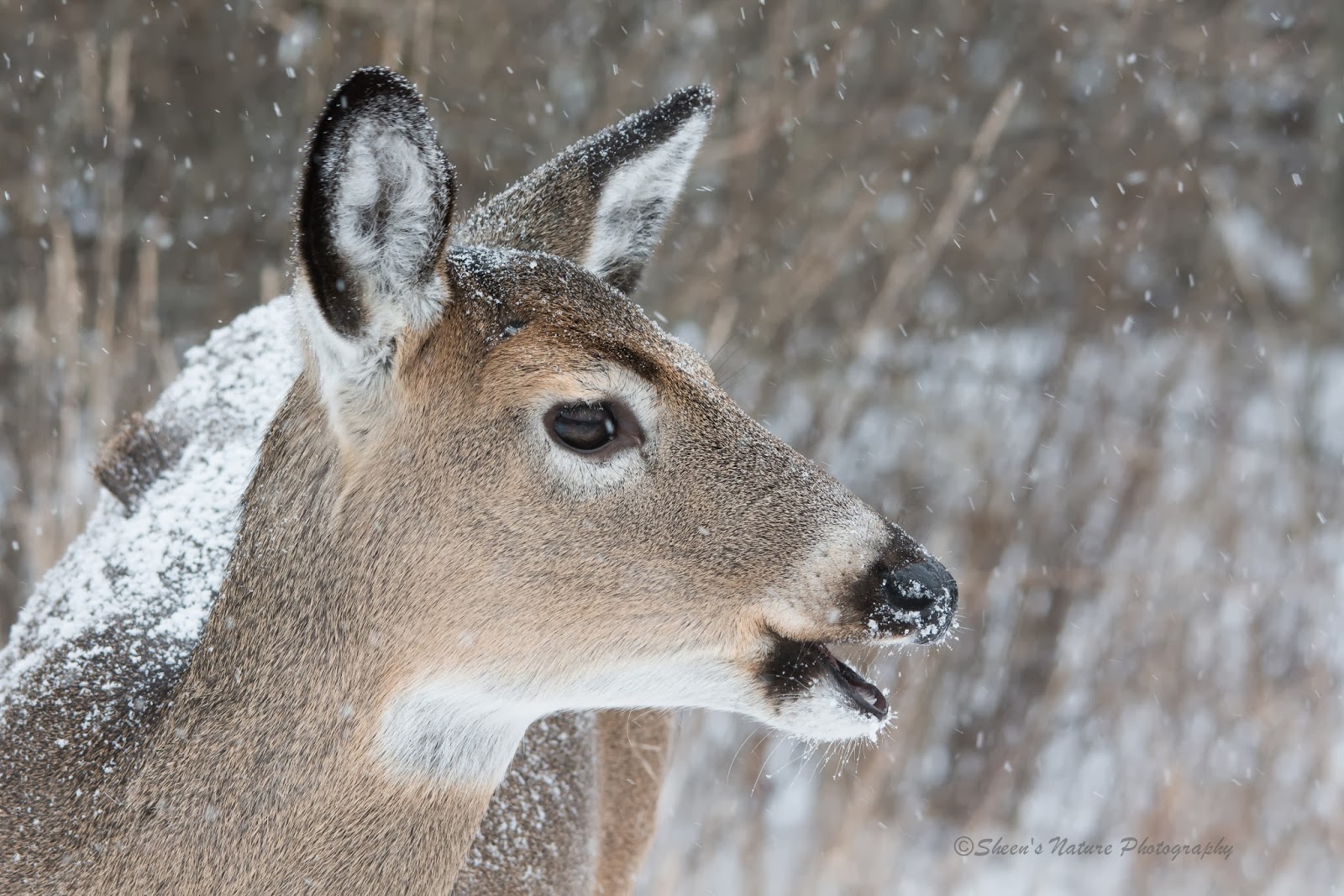
Deer Conversing with Nature by Sheen's Nature Photography
All deer images captured at the Lloyd A. Stage Nature Center
To find local parks and wildlife viewing go to your favorite browser and type in Wildlife Viewing near your town.  Then after a little planning,  grab your gear and go.

The next time you've had a "Worked Hard for the Money" day or week, don't let a "Baby It's Cold Outside" mindset stop you.  Reality, enduring memories and mother nature await.  HAPPY SHOOTING!


Thursday, November 28, 2013

The Checklist - It's Not about What I'm Packing

When planning our excursions  many of us create a checklist to ensure we don't forget the important items.

Cameras, lenses, remote, cleaners, spare batteries and filters.  Check.
Gloves, hat, sunglasses, snacks ((Erg Bar for long term energy), smart phone.  Check.

There's another checklist that I've found that I need to make.  It's the tactics checklist of what to remember when 'caught up in the moment' of your subject.

Underneath the Outer Banks Fishing Pier at Sunrise
Nikon 600, 14-24mm, f/16, ISO 100, 6 sec

On a recent trip, I had the privilege of shooting above and under piers in the the Outer Banks in North Carolina.  When processing the images in Lightroom,  there were specific shooting areas where I noticed a fundamental issue.  

I hadn't moved my perspective!  

Sure, different f/stops were used along with focal length adjustments.  But the perspective was from one location.   Almost all of the upper level pier shots had the same look and feel including horizon points.  This left very little to work with when back in Lightroom.  

What happened?

Fundamentally, I am a bird and nature photographer.  Because my subjects move, I constantly have to as well.  'Moving' around to the right, left, on the ground is the norm.  

When the objects became stationary, my tendency was to remain in one spot.  The outcome?  A lot of images that looked the same and there was not a lot to choose from.

Bodie Lighthouse after Sunset
Nikon 600,  14-24mm, f/8, ISO 50, 30 sec

Viewing images from the pier and lighthouses with limited perspectives generated the need for a mental  'in the moment'  tactics checklist.  This includes: 
  • Multiple f/stops
  • Multiple focal lengths
  • Multiple steps to the right and left from the initial shooting point
  • Taken from close to ground level
  • Taken from a higher point
  • Use of different lenses on the same subject when possible

Batteries are charged, camera gear and backpack is ready.  Mental list?  Check!

HAPPY SHOOTING!


Thursday, November 14, 2013

Is there such a thing as the "Affordable Photographers' Equipment Act?"

A common misnomer is that photography is a very expensive hobby.  There are many camera promotions today that make it easy to get started and grow with a modest investment.
Pure Sugar
Nikon 600, 70-300mm lens

Camera manufacturers, particularly during the holidays, offer special bundles.   Some of these include two lenses, camera bags, filters, flash units and a tripod.  Different retailers including local, national chains and online have different bundles so you'll want to do a little research. A kit that has a general purpose lens and a telephoto lens is highly encouraged.

Delicate Details of a Rose April 2012
Nikon 5100,  general purpose kit lens
My first camera was the Nikon 5100 and it's still in my toolkit.  The newer Nikon 5200 has a big sensor and more megapixels.  These bundle kits sell for around $1000.  Also note that Nikon's image processing software is included.  While I am a Nikon user, Canon also offers bundles.  Bundles will provide the fun, creativity and diversity needed by most recreational and family photographers.

The 1st Weekend of Camera Ownership April 2012
Nikon 5100, 55-300mm lens
To pursue photography beyond recreational usage, it will require additional investments.  "Great Glass'  otherwise known as a great lens does come at a price.  Macro, landscape and big telephotos can broaden your reach but as you'll read many times over, an expensive lens does not guarantee great images.  With the right composition, lighting, tools and techniques professional quality images are within your reach.

The other periphery expenses as you expand include higher powered image processing software such as Lightroom by Adobe and a relatively current PC.

The good news is that you can rent lenses before you buy and add at your own speed based on your interest and where you want to take your photography.

Happy Shooting!


Sunday, October 20, 2013

Up Close & Personal with Nature...Locally

Chestnut-sided Warbler, Northport, MI
Image was taken on a nature trail excursion
For bird and nature photographers to capture images that meet personal 'perfection' criteria, it takes the three "P's":  practice, persistence and patience.

Before the three P's can take hold, the photographer must have the right lighting, location, camera settings and a bit of luck in finding their subjects.

When subjects are spotted, that's when patience and persistence takes hold. Our little birds typically pose for a few seconds before darting off to another branch.

To be able to track your subject, select your camera settings, focus on the eye, it takes many snaps to get your desired image.

Where to practice?  Many towns have individuals, groups or even centers that's mission is to rescue injured wildlife and rehabilitate back to the wild when possible.   I have seen a few that work with photographers creating a win environment for both.

Barred Owl, The Howell Nature and Conference Center
A perfect poser in Steve Gettle's workshop
The Howell Nature and Conference Center offers many education forums for the Southeast Michigan region.

Steve Gettle, a widely published professional nature photographer conducts photography workshops at the center on a regular basis.  In October, he led Photography Workshop: Lighting and Composition.  There is a fee for the workshop that goes directly to the center in support of their mission.

This workshop offers students the privilege to photograph wildlife in a beautiful, natural setting with a lot of attention to the details.  A picture-perfect place to practice!

Another group in the Midwest is Back to the Wild in Castalia, Ohio. This group centers on rehabilitating and returning animals back to the wild.  They offer educational programs, share progress updates and rely on donations for support of their efforts.

Each spring during the The Biggest Week in American Birding they bring their birds of prey for demonstration and education that cannot be returned to the wild to Magee Marsh at Crane Creek near Oregon, Ohio.  Photographers can get within a close range as these birds are accustomed to seeing people and will give a pose or two.  A practice haven.  While not required, they accept donations during the demonstrations and online too.

Peregrin Falcon, a poser from Back to the Wild
Image taken in May 2013 during The Biggest Week in American Birding
By researching local non-profit wildlife groups you can take part in helping their cause and potentially get some 'practice makes perfect' time.  Happy Shooting!

Sunday, October 13, 2013

Behind Every Nature Photographer....

November Berries from Stoney Creek Metropark
Nikon 7000, 105mm, ISO 320, f/5.6, 1/320 sec
Whether a professional or passionate about the hobby, we have or have had a support system that allows us to grow and improve each time we're behind the lens.

This support system can include the influencer, the mentors, the camera experts, the photography buddies, and of course, your partner.

Surround yourself with people that feed your addiction!

The influencer - who do you know that is active in photography?  The friend that has a camera with them always - either a smart phone or actual camera.  You watch them taking pictures while standing beside them thinking, "I wish I had a camera".  If this is you, let the influencer do their job.  Either pull out that camera sitting in the box out or go buy one!

The mentors - in today's social media world, there are many fantastic photographers networking on Facebook pages, Google pages, Twitter and other platforms.  There are also social media pages that share other artists works.  A few of these Facebook sites include:  MegashotSoulful NatureNature Photography Wildlife Photography, and Audubon Magazine.  On google pages, just find your communities of interest. The Birds 4 All community on Google+ as an example is dedicated to bird photography.

Mary artists on these pages are forthcoming with their settings, lenses used and general tips.  Just ask!

Early Fall Sunshine
Nikon 5100, 105mm, ISO 320, f/14, 1/6 sec
The camera experts - your camera's website is the most accurate place to go for the latest specs.  Our web hosts many technical reviewers, sources and materials.  Even with all the great information on the web, the best advice may come from your local camera dealer.  Talk to their experts, show them your work, ask for feedback - you'll get invaluable tips and ideas. In southeast Michigan, it's Woodward Camera.

Photography mentoring buddies - similar to the influencer and the mentor, you'll find a few go-to mentoring buddies that are great to go out in the field with and observe their perspective on subjects.  I have a few that I haven't met face to face but if I need help, they serve as a faithful 'how-to' lifelines.  These are photographers who share subject interests. They reciprocate feedback and conversation.  Check out their talented, varied nature photography work on Facebook:  Bruce Leonhardt PhotographyCraig Sterken PhotographyNathaniel Smiley PhotographyRose Marie's Pictures.  There are photography couples that share the passion side-by-side - 2 Browns Photography and Birgit and Juergen Pictures.

Your partner - you've been in the cold, the wet, the hot, the dry.  All the while, your partner showed patience until the bitter end when you've become a bit snap-happy.  Our partners show intense interest in our work, witness our progress and serve as a tie-breaker when deciding which image to use.

Starting the Day with a Song
Nikon 5100, 70-300 mm, ISO 320, f/9, 1/1000 sec
You - you are the artist behind the camera.  That image was not a result of 'having a camera that takes good pictures'.  Your images are personal, they share with others your eye of your subject.  They are a result of your work, study, patience and perseverance.

HAPPY SHOOTING!

Tuesday, September 17, 2013

Time - Life Lesson from Behind the Lens

Our personal interests can teach many life lessons.  Nature photography is no different.  Some lessons in photography are probably obvious, such as looking at your image as well as business challenges from multiple perspectives.

However some lessons are not so apparent, until you see them taking hold in both your photography and your approach to life.   One lesson is the use of time, it's definition quite elusive depending on your perspective.  It's the one thing that cannot be bought, shortened, or extended.  A precious, precious commodity.

In nature photography, each day has a limited amount of time that maximizes the quality of a given type of image we are shooting for.

The minutes before and after a sunrise where the soft rich rose hues cascade across our landscape.

The World Awaits by ©Sheen's Nature Photography

The early to mid-morning time frame where bees, other insects and birds start off by moving slowly before elevating to a darting, rapid pace.

Oh What a Beautiful Morning! ©Sheen's Nature Photography

The midday sun where direct overhead light can be made to work for areas where you don't want shadows.

Don't Forget the Sunscreen.... ©Sheen's Nature Photography

And then sunset, where glowing red to amethyst skies sweep in before nightfall.

So Long, Farewell Until Tomorrow.....©Sheen's Nature Photography

Nature Photography awakened the need to be more aware and in some cases, a bit selfish with time.  Family, fur-children will always take priority.

All aspects of nature - birds, foliage, landscapes, nightscapes - have their individual peaks in each of the four seasons.  These peaks become guideposts as to how and where we will spend our personal time.

The result?  Wonderful memories in the mind, the heart and forever on digital that serve as visible reminders of time joyously spent.

How will you spend your free time today?  Happy Shooting!


Wednesday, July 31, 2013

About the Birds and the Bees....the Pollinators

The 'birds and the bees' and the 'flowers and the trees' can have multiple meanings, depending on who you ask.  For nature photographers (and gardeners), they represent amazing wonders to be shared.

Lunching Goldfinch image
 Nikon 5100 55-300mm
Let's start with our birds.  They need protein-rich foods that come from seeds and insects.  When we plant native flowers and trees we are supporting and sustaining their food chain.   Learn more about Bringing Nature Home: How You Can Sustain Wildlife with Native Plants through the website and informational book.

The female goldfinch pictured to the right efficiently uses the thistle-seed for nutrition and the thistledown (soft fibers) for nesting material.  Thistle flowers are a beautiful, vibrant purple and their downy material provides wonderful, artful interest in the fall.  If you like goldfinches - plant thistle in your garden!

You and the birds will be rewarded with a frenzy of cheerful, colorful activity.  Since their food and nesting source blooms later in the season, you may also have another round of bird families in your own personal habitat.

Little bluebird of happiness, Nikon 70 - 300mm


Eastern bluebirds enjoy insects and
invertebrates. 2/3 of their diet comes from grasshoppers, crickets, katydids and beetles.  The other 1/3 is made up of wild fruits.  Pesticides, insecticides can take away their food sources quickly.


For additional insight into habitat trends and planting native plants visit Saving Birds Thru Habitat, where Kay Charter and the volunteer group live by example in "Helping to improve habitat for migrating birds one backyard at a time."

And now for our precious, life-sustaining bees.  There are many described species of native bees that pollinate wildflowers and crops.  The bad news is that the population, the honey-bee in particular, is on a serious decline.  The global impact to crop growers and ultimately consumers is and will continue to be costly.  National Geographic's article The Plight of the Honeybee shares our current state and actions being taken.

Honeybee savoring breakfast on spring morning
Nikon 105mm

There's a website where you can learn more about these colorful pollinators and how you can help including planting native plants in your garden and neighborhoods:  www.pollinator.org Also, check out 18 different species of bees on this Identifying Native Bees Poster.

Sweet Sweat Bee enjoying a native Chicory flower
Nikon 600 105mm
Nature photographers have the privilege of sharing birds, animals and insects in action.

Skills of patience, discipline, creativity and anticipation of the 'next move' are crucial for images that pull the viewer in to the environment.  

Before we capture an image, the fundamental element, our environment must be managed and protected by all of us.  Let's all do our part and plant native plants this summer and fall.


Wednesday, July 24, 2013

So What's in Your Camera Bag?

Whether new or established in photography, one thing is for sure.  What's in your camera bag is important.  No, we're not talking about Nikon vs. Canon, lenses, or other camera gear.  This is a bit more fundamental.  Outdoor photographers do not go out for a few minutes to take a few images and head back into the house.  We easily can spend one half hour on one tiny bird, bee or flower.
Wonderful warbler nest building discovery during 4 hour photo walk

This is about being able to stay in the field energized with the long term ability to focus on your subject and make snap (pardon the pun) decisions on f/stops, shutter speeds, ISO, aperture, etc.

This is about snacks.  Seriously?  Absolutely.

You wouldn't go out for a long hike without water and food.  With nature photography, hiking is a almost a given. Our equipment can be heavy - multiple cameras, lenses, tripods.  We exert a lot of energy before capturing our first image.

With many food products out on the market for endurance athletes, there are many snacks that are suited for endurance photographers too. They are tasty, fast to eat and help extend your energy without needing to drink caffeine multiple times per day.  Additionally, being easy to pack and not easily torn as to get ooey-gooey food on any of your gear is another important factor.  So here are some recommendations of products you can find just about anywhere.

Small compact snacks:
Sport beans are fun and you only need a few, Shot bloks - while chewy are also good. 1 or 2 will help provide sustained energy - both of these should be consumed with water to be effective.  Luna bars also work great and are a bit more fillling if you have that 'I need something substantial' feeling.  A new product ERG is a recent find, my current go-to bar  and one of my all-time favorites from a Michigan-based company - gluten free, natural ingredients, no preservatives and terrific flavors.

Female bluebird busy with her spring home
Pack your own snacks:
If you have a Trader Joe's or something similar -  there are buy in bulk fruit/nut snacks of all combinations that allow you to load your choices in a zip lock bag - reuse these whenever possible!  Dry cereal - frosted mini-wheats, your favorites - can work in a pinch.  Costco offers rice crackers that are gluten free and have a low glycemic index (which means our energy lasts longer check out Low Glycemic Information, Nutrition Data).

A snack that could defy Dr's Orders:
Beef Jerky while loaded with sodium is protein packed, comes in resealable packages and is just plain good.  Be careful, you could attract a bear or two.

And for those of us who convince our partners to join our journey for the day - a nice touch is to pack an ice-cooler of a light lunch and beverages for a surprise picnic to reward them for their patience with us.

Happy shooting!


Wednesday, July 17, 2013

Protect It....and They Will Come...Back...

Pure Sweetness by Sheen's Nature Photography

Pure Sweetness , a Piping Plover photo by Sheen's Nature Photography on Flickr.
Nature photographers love to get up close and personal with their subjects. In addition to lighting and location there is one crucial element that has to happen before we even get started. The thriving and surviving of our subjects' habitat.

Many articles, documentaries and environmentalists have so much information that it can be overwhelming. Throughout all of their research there is a common thread - awareness and protection.

Let's take the precious Piping Plover which has been on the Michigan endangered list since 1986.  Natural predators are foxes, crows, gulls, etc. combined with human disturbance.

Additionally, to quote Kay Charter, founder of Saving Birds Thru Habitat "It's not only humans that cause problems, an increase in many other species that predate on these ground nesters take an incredible toll. We can all help by giving them their space and by keeping our pets away from their nesting and foraging areas." The Piping Plover's protection is their camouflage - with their nests being on the ground they are exposed to many hazards. If disturbed too much, they will abandon their nests.

The Piping Plover has not been seen in the Northern Leelanau Michigan area for 8 years. Yet this year there are 2 families about 5 miles apart with chicks being born just last week.
Nap Time - Piping Plover Chick,  Sheen's Nature Photography 

So what brought them back? Hopefully, it's the optimal environment for breeding for sustained livelihood on the peninsula!

For many years, dedicated organizations like The Leelanau Conservancy are intentional about every action they take with regard to protecting land and the environment.  Over the course of time they have forever protected 10,000 acres of spectacular views, sensitive wetlands and working farms.

Members of  The Leelanau Conservancy have also been communicating frequently with Saving Birds Thru Habitat and the Department of Natural Resources on the recent return of the Piping Plover. It takes multiple organizations and individuals partnering to document activities, safeguard their environment to bring future returns.                                                                                                                

These little juveniles have a 30% chance of survival to adulthood - they need a lot of help!
Proud Papa Piping Plover, by Sheen's Nature Photography

Wednesday, July 10, 2013

The Not So Obvious Destinations....

We all have our favorite go-to places for nature & bird photography. When seeking photo subjects it's also energizing to find new places through travel or local jaunts. What the years of birding (before diving in to photography) taught was that some of the best nature sights are not always in the 'destination wedding' locations.

Take the Pretty In Pink dragonfly....brilliant colors along side a beautiful blue water setting. Yet, this image was captured at the Hornsby Bend Water Treatment facility in Austin, Texas. Check out the Hornsby Bend Observatory website.

Of all the lovely places to visit in the Live Music Capital of the World...a few hours were spent amidst slightly odorous waters, muddy, buggy, yet very safe conditions. Other sitings here have included Glossy Ibis, Pintail Ducks, Yellow-headed blackbirds, Black Noddy, Sora rails and amazing insects and butterflies. A definite go-to spot for nature enthusiasts.

In a Marietta business park near Atlanta last fall, there were hundreds of monarchs just flitting and hanging out in the beautiful landscapes - tremendous photo opportunities. (Sadly, a business trip so no camera). Typically, we don't think of going to a business park on the weekend. Your neighboring business parks may have created nature friendly areas filled with flowers, shrubs that attract beautiful subjects. In Birmingham, Alabama it was a pleasant walk through another business park's landscaping watching Brown Thrashers and Eastern Towhee's flitting about closely as they are not shy of the daily influx of people.

Grooved-bill Ani's hang out in a "Dump" site in SouthTexas near the Santa Ana National Wildlife Refuge.   Check out Friends of South Texas National Wildlife Refuges where you'll see Great Kiskadee's, Chachalaca's, etc..   On the Leelanau Peninsula in Michigan, Snowy Owls are seen on farmlands in winter.  Now, that was an awesome, chill-bump experience!  I'll share that one in a later blog.

Recently at a baseball diamond beside Crescent Lake, Monk Parakeets fussed and groomed on the chain link fence in St. Petersburg, FL.

It takes a little detective work on the internet, networking with other photographers and reaching out to local birders and nature groups. Just this week via Google+ photography networking, I discovered a nature area one hour away that is on my radar for this weekend.

You can readily find new local gems where nature all but waits for the camera. Happy shooting!

Monday, July 1, 2013

Back to the Wild - One Rescue at a Time

As nature photographers, it is a privilege to capture images of nature in the wild. Whether it is our favorite spots, a planned visit to a new location or a surprise sighting when you happened to have the camera handy - seeing nature first hand creates fast heart beats and draws out emotions.

We also get exposed to great organizations dedicated to preserving and protecting our subjects. The Castalia, Ohio Back to the Wild rescues over 2500 animals each year with a return rate of 60% back to their habitat.

In their journey, they provide the community with education and access to rescued animals. This image is from their education event at Magee Marsh during the Biggest Week in American Birding.

Every time nature photographers share an image - we are touching someone. It may be education (what type of 'bird' is that), inspiration (I want to go and see that 'bear' in the wild) and exposure (for those who cannot venture out due to health, etc).

So a special thanks to Back to the Wild and the many other volunteers and photographers who share their stories and images.